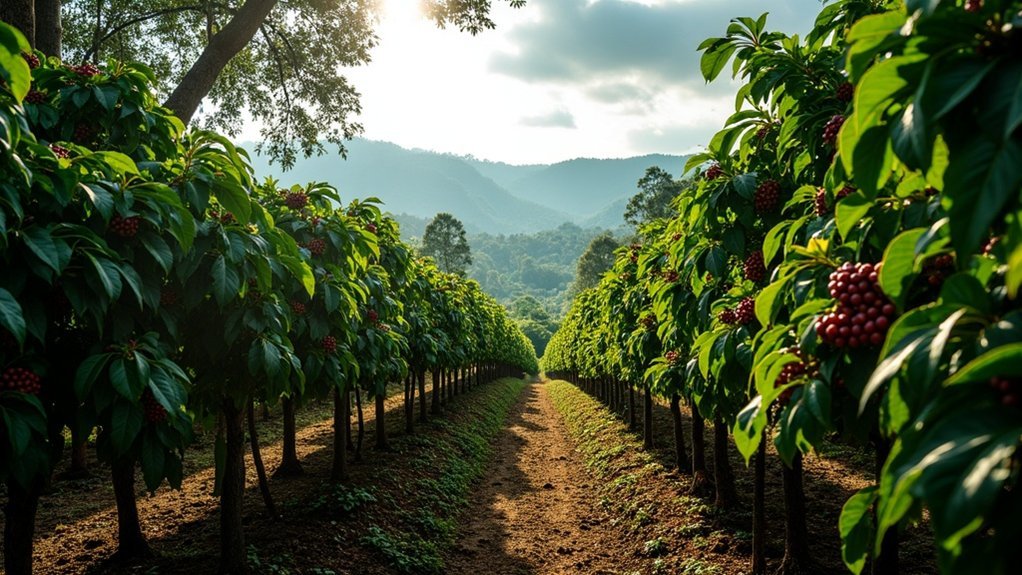
Indonesian coffee grows in several key regions across the archipelago, each offering unique flavor profiles that coffee enthusiasts cherish. Sumatra, with its fertile volcanic soil, contributes significantly to the coffee output and is renowned for its earthy notes. Java is known for producing rich, full-bodied coffee, while Sulawesi, particularly from Toraja, showcases delightful nutty aromas. Flores and Papua also stand out for their distinctive characteristics, with specific processing methods enhancing their flavors. Explore how each region contributes to the rich tapestry of Indonesian coffee.
Key Takeaways
- Indonesian coffee is cultivated in various regions, including Sumatra, Java, Sulawesi, Flores, and Papua, each offering distinct flavors and profiles.
- Sumatra stands out as the largest coffee-producing region, accounting for 60-75% of Indonesia’s total coffee output, with many smallholder farms employing organic farming methods.
- Coffee from Java thrives in volcanic soil, resulting in rich flavors with low acidity, and is well-known for its Old Java variety.
- Sulawesi, particularly the Toraja area, produces coffee at high elevations, celebrated for its nutty and chocolatey aromas.
- In Flores and Papua, coffee is grown at high altitudes, where organic practices and wet-hulling techniques are used to enhance flavor complexity.
Overview of Indonesian Coffee Regions
When exploring Indonesian coffee, you’ll discover that the country’s diverse regions each offer distinct flavor profiles and characteristics, greatly shaping its coffee production.
Sumatra dominates, contributing 60-75% of total output through giling basah, resulting in low acidity and a heavy body that coffee enthusiasts appreciate.
Sumatra leads Indonesian coffee production, known for its low acidity and rich, heavy body that coffee lovers cherish.
Java, cultivated on the Ijen Plateau, delivers rich, full-bodied coffee with notes of molasses and clove, making it a favorite among those who enjoy complex flavors.
Sulawesi, particularly from the Toraja highlands, produces a lighter yet bold flavor profile with nutty and chocolatey aromas, appealing to a wide range of palates.
Flores coffee, grown at elevations between 1,200 and 1,800 meters, features sweet chocolate, floral, and woody notes, showcasing the remarkable versatility of Indonesian Arabica varieties.
Each region’s unique characteristics contribute to the rich tapestry of Indonesian coffee, inviting exploration and enjoyment.
Sumatra: The Heart of Indonesian Coffee
In Sumatra, unique growing conditions, including fertile volcanic soil and a tropical climate, greatly influence the quality of coffee.
The region’s flavor profile, characterized by earthy and chocolatey notes, is a direct outcome of its giling basah processing method.
Additionally, the cultivation practices employed by smallholder farmers, often organic and traditional, significantly enhance the richness of Sumatran coffee, making it a distinctive choice for coffee lovers.
Unique Growing Conditions
Sumatra’s unique growing conditions are crucial in defining the exceptional qualities of its coffee. The island’s fertile volcanic soil creates an ideal environment for cultivation. Arabica coffee flourishes at altitudes between 1,200 and 1,800 meters, where it benefits from cooler temperatures and plentiful rainfall. The giling basah processing method further elevates the coffee’s low acidity and intricate flavor profiles. Here’s a summary of these conditions:
| Aspect | Description | Impact on Coffee |
|---|---|---|
| Soil Type | Fertile volcanic soil | Rich flavor development |
| Altitude | 1,200 – 1,800 meters | Cooler temperatures |
| Processing Method | Giling basah | Low acidity, thick body |
Flavor Profile Characteristics
While exploring the flavor profile characteristics of Sumatra coffee, you’ll discover a fascinating blend of earthy, creamy, and chocolatey notes that reflect the island’s unique growing conditions and processing methods.
Sumatra coffee is known for its low acidity, a result of the fertile volcanic soil and high humidity where coffee beans thrive. The unique giling basah processing technique enhances its complex flavor profile, producing green beans with a distinctive bluish hue.
Major varieties like Mandheling, Lintong, and Gayo showcase smooth bodies and intricate flavors, making them highly sought after in the specialty coffee market.
Indulge in the richness of Sumatra’s coffee offerings!
Cultivation Practices and Techniques
As the largest island in Indonesia, Sumatra plays a pivotal role in the country’s coffee cultivation, leveraging its fertile volcanic soil and tropical climate to produce high-quality beans.
Over 90% of coffee here comes from smallholder farms practicing organic methods. The primary focus is on Arabica production, utilizing the wet hulling technique, which enhances low acidity and complex flavors.
Varieties like Mandheling, Lintong, and Gayo thrive in this environment, benefiting from the region’s average temperatures of 26 to 30°C and substantial rainfall.
The harvest season from November to March ideally develops the cherries’ flavor profiles, essential for producing exceptional coffee.
Sulawesi: Unique Flavors From the Toraja Region
Nestled in the high-altitude Toraja region of South Sulawesi, coffee cultivation thrives at elevations between 1,600 and 1,800 meters, significantly influencing its unique flavor profile.
Renowned for its nutty and chocolatey aromas, Toraja coffee features a creamy texture and a bold, full-bodied taste. The mountainous terrain and rich biodiversity contribute to its complex flavor, as coffee plants grow alongside various fruit trees.
Traditional farming methods utilized by smallholder farmers ensure high quality, with hand-picked cherries reflecting sustainable practices.
The region’s remote accessibility enhances the allure of Toraja coffee, celebrated for its artisanal qualities and exclusivity among coffee enthusiasts.
Java: The Island of Coffee Heritage
Java holds a pivotal role in coffee history, having been introduced to the island by the Dutch in the 17th century.
The unique growing conditions of the Ijen Plateau, combined with the washed processing technique, produce coffee with distinctive flavor profiles that are celebrated worldwide.
Understanding these elements is essential to appreciating Java’s contribution to Indonesia’s rich coffee heritage and its impact on the global coffee scene.
Historical Coffee Significance
Since the late 1600s, Java has been a key player in the global coffee trade, marking its position as the first Indonesian island to cultivate this cherished crop.
The historical significance of Java in coffee production can be highlighted as follows:
- The Dutch introduced coffee seedlings to the island, greatly enhancing its agricultural landscape.
- In 1711, Java made its first coffee export to Europe, signifying Indonesia’s entry into international markets.
- From 1725 to 1780, the Dutch East India Company held a monopoly on coffee production, benefiting colonial powers while farmers faced challenges.
- Java coffee is known for its low acidity and rich flavor profile, featuring notes of molasses, clove, and figs, which set it apart within the Indonesian coffee scene.
Unique Growing Conditions
The unique growing conditions on Java significantly enhance the quality and flavor profile of its renowned coffee.
The Ijen Plateau, situated at an elevation of approximately 1,300 meters, offers optimal conditions for arabica coffee cultivation. The volcanic soil found on Java enriches the coffee’s distinct flavor while contributing to its low acidity, resulting in a cleaner and more refined taste profile.
Java coffee is processed using the washed method, unveiling rich notes of molasses, clove, and figs.
Furthermore, the island’s fertile terrain holds historical significance, as some estates age their coffee for up to three years, creating unique flavors known as Old Government, Old Brown, or Old Java.
Processing Techniques Used
Five primary processing techniques define the character of coffee produced on Java, with the washed method being the most prominent. This technique enhances Java coffee’s cleanliness and sweetness, resulting in low acidity and a full body.
The unique volcanic soil contributes to the following flavor notes:
- Molasses
- Clove
- Figs
- Rustic flavors (especially in Old Java)
During the washed process, the coffee cherries are fermented to remove mucilage, allowing distinct processing methods to shine through.
The aging of Java coffee further deepens its complexity, giving rise to unique varieties like Old Java, characterized by their rich, rustic flavor profiles.
This website is dedicated to all things coffee.
Bali: A Tropical Paradise for Coffee
While exploring the nuances of Indonesian coffee, you’ll quickly discover that Bali stands out as a tropical paradise for coffee production.
Nestled in the Kintamani highlands, coffee plants thrive at elevations of 1,200 to 1,600 meters, benefiting from the region’s volcanic soil. This unique soil contributes to a complex flavor profile, often featuring notes of citrus, floral, chocolate, and walnuts.
Farmers typically employ washed processing, yielding a clean body without bitterness. The tropical climate, with its high humidity and rainfall, guarantees ideal growing conditions, producing coffee known for its mild intensity and sweet acidity, making it a favorite among coffee enthusiasts.
Flores: Coffee From the Rugged Terrain
Nestled between the rugged hills and valleys of Flores, coffee thrives in an environment that remarkably enhances its distinct characteristics. Grown at altitudes of 1,200 to 1,800 meters, Flores coffee benefits from fertile volcanic soils and a unique climate.
Key factors include:
- Wet-hulling process: This method produces a sweet, milk chocolate flavor with floral and woody notes, making it a favorite among coffee aficionados.
- Syrupy body: The rich and full-bodied profile appeals to specialty coffee enthusiasts seeking depth in flavor.
- High rainfall and humidity: These conditions are ideal for Arabica coffee cultivation, contributing to the beans’ exceptional quality.
- Intercropping: This practice boosts biodiversity, promoting overall plant health and enhancing the coffee’s unique flavors.
This perfect combination results in exceptional, complex coffee that showcases the best of Flores’ unique terroir.
Papua: Rare and Unique Coffee Production
Papua stands out in the coffee world for its rare and unique production methods, particularly in the Baliem and Kamu Valleys. Here, high-altitude conditions, ranging from 1,400 to 2,000 meters, foster the growth of exceptional Arabica coffee.
Farmers employ organic practices, utilizing shade trees and avoiding chemical fertilizers, resulting in rare beans with distinctive flavors. The region’s wet-hulling method further enhances the coffee’s complexity, often delivering rich floral notes and fruity undertones.
With annual production at only 230 tons, Papua‘s remote farming practices and rich biodiversity contribute to its exclusivity, making its coffee highly sought after by connoisseurs.