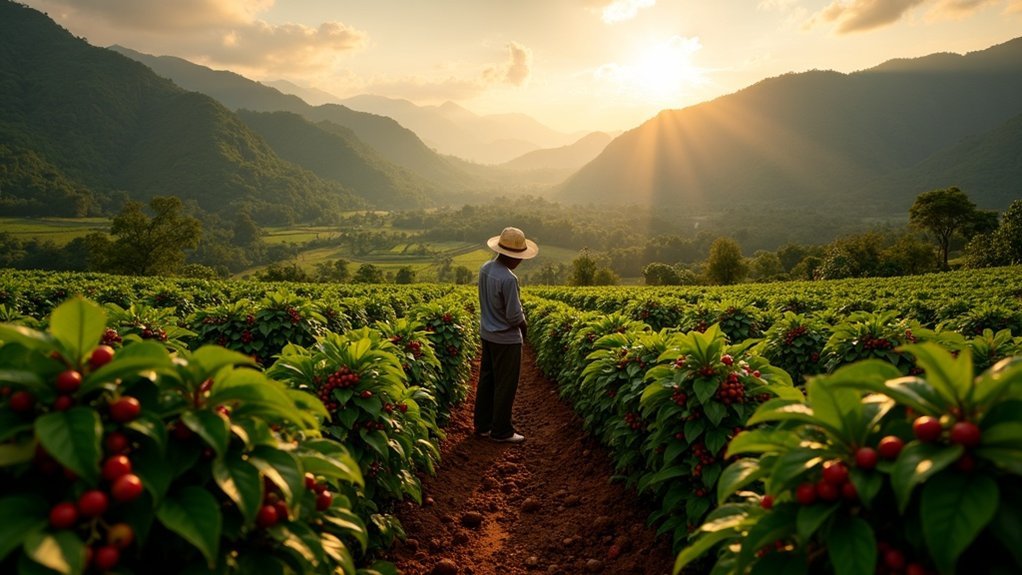
Burundi coffee thrives in regions such as Kayanza, Ngozi, Gitega, Karuzi, and Ruvubu. These areas boast rich volcanic soils and high altitudes, creating optimal conditions for cultivating Arabica coffee plants, especially the Red Bourbon variety. Farmers in these regions employ traditional washed processing methods, which enhance the coffee’s distinct fruity and floral notes. As you delve deeper, you’ll discover the unique characteristics that each region contributes to the coffee’s exceptional flavor profile.
Key Takeaways
- Burundi coffee primarily thrives in regions such as Kayanza, Ngozi, Gitega, Karuzi, and Ruvubu.
- The coffee is cultivated at elevations ranging from 1,200 to 2,000 meters above sea level.
- The Red Bourbon variety of Arabica coffee is the dominant type grown in these regions.
- Each area utilizes traditional washed processing methods, which enhance the coffee’s unique flavor profile.
- Smallholder farms play a crucial role in coffee production, with many managing less than one hectare each.
Overview of Burundi’s Coffee Growing Regions
Burundi’s coffee-growing regions are a treasure trove of unique flavors and high-quality beans. Nestled at altitudes between 1,200 and 2,000 meters, regions such as Kayanza, Ngozi, and the Ruvubu area contribute to the exceptional quality of Burundi coffees.
Here, Arabica coffee plants thrive, particularly the Red Bourbon variety, celebrated for its rich flavor profile. The traditional washed processing methods used in these regions enhance the beans’ qualities, making them highly sought after on the global market.
With a harvest period spanning from February to June, Burundi’s annual coffee exports reflect its dedication to quality, totaling around 246,000 bags each year.
Gitega Region
In the Gitega region, you’ll discover coffee that truly stands out, notably for its Bourbon varietal, celebrated for its remarkable quality.
The washed processing technique employed here not only elevates the coffee’s clean and fruity flavors but also showcases Gitega’s perfect growing conditions, characterized by its high altitude and fertile volcanic soil.
Coffee Varieties Grown
The Gitega region is renowned for its exceptional Bourbon coffee, a prized Arabica variety celebrated for its rich flavor and high quality.
This coffee thrives on small farms, typically less than one hectare, which allows for unique microlot offerings. The fertile volcanic soils and ideal climate contribute to the coffee’s distinct sweetness and complex flavor notes, making it a favorite in specialty coffee markets.
With its washed processing method, Gitega coffee emphasizes clarity and brightness, showcasing its true essence.
Exploring these coffee varieties will deepen your appreciation for the remarkable qualities and differences found in Burundi coffee.
Processing Techniques Used
While exploring the processing techniques in the Gitega region, you’ll find that the washed method stands out as a key approach that enhances the coffee’s clarity and brightness.
Producers often employ dry fermentation techniques to efficiently remove the mucilage from coffee cherries before washing. This meticulous coffee processing is essential, as sorting techniques guarantee that only the highest quality beans reach the market.
Each washing station in Gitega plays an important role, blending local beans with those from nearby regions while preserving distinct flavor characteristics.
The average farm size, less than one hectare, encourages centralized delivery for consistent processing outcomes, ensuring that the coffee produced is of exceptional quality.
Karuzi Region
In the Karuzi region, the unique combination of fertile volcanic soil and an ideal climate creates perfect conditions for coffee cultivation.
The altitude, ranging from 1,200 to 2,000 meters, plays a vital role in developing the rich flavors of varietals like Bourbon and French Mission Bourbon.
This exceptional environment not only enhances the qualities of the coffee beans but also positions Karuzi as a standout in the specialty coffee market, making it a must-try for coffee enthusiasts.
Climate and Soil Quality
Nestled in the heart of Burundi, the Karuzi region boasts an ideal climate and soil quality that are essential for coffee cultivation.
With average temperatures around 21º C and an annual rainfall of about 1,200 mm, the region’s temperate equatorial climate supports healthy coffee growth.
The rich volcanic soil enhances nutrient availability, fostering the Arabica variety that flourishes at high altitudes between 1,200 to 2,000 meters.
These unique conditions not only contribute to the vitality of the coffee plants but also result in a mellow, well-balanced flavor profile, making Karuzi coffee highly sought after in the specialty coffee market.
Coffee Varietals Grown
The Karuzi region primarily cultivates Bourbon coffee varietals, which are celebrated for their rich flavor profiles and exceptional quality.
In Burundi, coffee thrives at elevations between 1,250 and 1,800 meters, where the volcanic soil and favorable climate contribute to the unique characteristics of the coffee.
As a coffee producer, you’ll find that washed processing methods enhance the clarity and brightness of the coffee’s flavors, resulting in floral notes and balanced acidity.
Due to the small average farm sizes, typically less than one hectare, coffee farming often involves centralized washing stations for processing, ensuring high standards and consistency in the final product.
Kayanza Region
The Kayanza region of northern Burundi is celebrated for its exceptional coffee, specifically its unique blend of altitude and volcanic soil that nurtures some of the world’s finest Arabica varieties, especially Bourbon.
Coffee trees flourish at elevations ranging from 1,200 to 2,000 meters, yielding Burundi green coffee beans characterized by bright acidity and vibrant citric notes.
Smallholder farmers, each tending to around 250 trees, play a significant role in the region’s coffee production.
The harvest period spans from March to July, during which Kayanza coffees consistently achieve high scores in quality assessments.
This makes them highly sought after in both local and international markets, prized for their distinctive flavors.
Kirundo Region
The Kirundo region is a remarkable area in Burundi’s coffee landscape, known for producing exclusively Arabica varieties that flourish in its rich, volcanic soils. With elevations ranging from 1,250 to 2,000 meters, this region provides the perfect environment for cultivating vibrant coffee beans. The consistent rainfall and equatorial climate contribute to the nuanced flavors that distinguish Kirundo’s coffee. Utilizing the washed processing method, these beans yield an exceptional medium roast that coffee enthusiasts will appreciate.
| Feature | Description | Impact |
|---|---|---|
| Soil Type | Volcanic | Enhances flavor complexity |
| Altitude | 1,250 – 2,000 meters | Promotes quality growth |
| Processing Method | Washed | Produces clean profiles |
Muyinga Region
Muyinga is a vital coffee-producing area in Burundi, recognized for its fertile volcanic soil and optimal climate conditions that foster the growth of high-quality Arabica coffee.
The region predominantly cultivates Bourbon varietals, which play a significant role in its overall coffee production. With a population exceeding 2.25 million, many families manage around 250 coffee trees each, showcasing the community’s strong ties to coffee farming.
Bourbon varietals dominate Muyinga’s coffee production, reflecting the community’s deep-rooted connection to farming.
The harvest season runs from March to July, with processed beans being exported to international markets between October and December.
The coffee from Muyinga is renowned for its unique fruity and floral notes, making it a sought-after choice among specialty coffee lovers.
Ngozi Region
Nestled in the heart of Burundi, the Ngozi region is a vital contributor to the country’s coffee industry, owing to its advantageous high altitudes that range from 1,200 to 2,000 meters.
Here, farmers primarily cultivate Arabica coffee, with a particular focus on the Bourbon variety, celebrated for its clean and delicate flavors. The region’s volcanic soils enrich the beans, enhancing their rich flavor profiles and bright acidity.
The harvest season occurs from March to July, with beans making their way to markets between October and December. Ngozi’s coffees are renowned for their fruity and floral notes, making them a prized selection among specialty coffee enthusiasts.