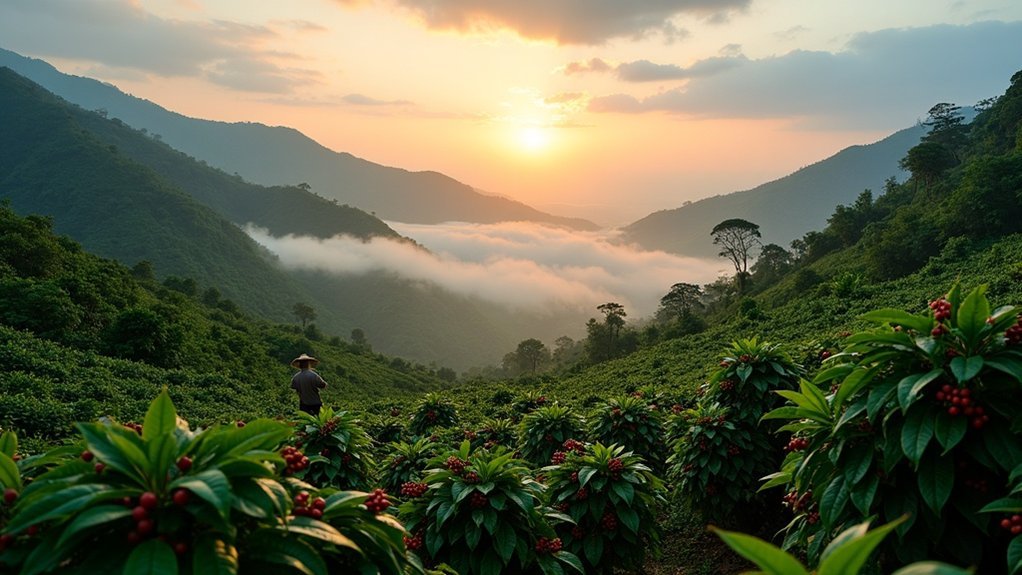
Indian coffee primarily thrives in the southern states, with Karnataka recognized as the coffee capital, contributing over 70% of the country’s production. Kerala is noted for its rich Robusta varieties, while Tamil Nadu specializes in Arabica, enhancing the diversity of Indian coffee. Additionally, emerging regions like Andhra Pradesh and Odisha are gaining recognition for their unique Arabica offerings. Each of these areas provides distinct flavors, nurtured under specific climatic conditions. Join us as we delve deeper into these regions and their cultivation practices.
Key Takeaways
- Indian coffee primarily thrives in the southern states of Karnataka, Kerala, and Tamil Nadu.
- Karnataka stands out as the largest producer, contributing over 70% to India’s overall coffee production.
- Kerala specializes in Robusta coffee, making up approximately 20% of the country’s total output.
- Tamil Nadu is known for its Arabica coffee, with notable production from the scenic Nilgiris and Pulneys regions.
- Additionally, emerging areas such as Andhra Pradesh and Odisha are cultivating both Arabica and Robusta varieties, further diversifying India’s coffee landscape.
Overview of Coffee Growing Regions in India
When you explore the coffee-growing regions of India, you’ll find that the southern states—Karnataka, Kerala, and Tamil Nadu—dominate the landscape of this beloved beverage.
Karnataka leads the way, contributing over 70% of the country’s coffee production, with regions like Kodagu, Mysore, Chikmagalur, and Hassan thriving in ideal conditions for both Arabica and Robusta beans.
Kerala follows, accounting for around 20% of India’s coffee output, primarily cultivating Robusta in areas like Wayanad and Travancore.
Meanwhile, Tamil Nadu contributes about 5%, focusing on the cultivation of Arabica coffee grown in the scenic Nilgiris, Pulneys, and Salem districts.
Together, these states create a rich tapestry of flavors and coffee varieties that delight coffee enthusiasts across the globe.
Karnataka: The Coffee Capital
Karnataka stands out as the heart of India’s coffee production, contributing over 70% to the nation’s output. With an annual production of around 2.33 lakh metric tonnes, this state is home to major coffee-growing regions like Kodagu, Mysore, Chikmagalur, Hassan, and Shimoga.
Notably, Kodagu accounts for 33% of India’s total coffee production. In Karnataka, Robusta coffee predominates, making up about 68% of the state’s yield, while Arabica thrives at higher elevations.
The coffee plantations flourish in the favorable climate of the Western Ghats, producing smooth, mild flavors that are beloved in both domestic and international markets.
Kerala: The Land of Robusta
Kerala: The Land of Robusta
While often overshadowed by its neighbor Karnataka, Kerala proudly stands as the second-largest coffee-producing state in India, contributing around 20% to the nation’s total output. Renowned for its robust Robusta coffee, the state primarily cultivates this variety in the lush regions of Wayanad and Travancore. The humid tropical climate of Kerala provides an ideal environment for coffee growth, resulting in an impressive annual yield of approximately 67,700 Metric Tonnes. These plantations not only focus on coffee production but also promote biodiversity by cultivating coffee under shade alongside other crops such as pepper and cardamom.
| Key Aspects | Details |
|---|---|
| Production | 67,700 Metric Tonnes |
| Main Type | Robusta (over 65,000 Metric Tonnes) |
| Farming Practices | Traditional, promoting biodiversity |
Tamil Nadu: Diverse Cultivation
When you explore Tamil Nadu’s coffee landscape, you’ll find a rich tapestry of key regions like the Nilgiris, Salem, and Coimbatore, each offering unique conditions for coffee cultivation.
The state’s focus on Arabica beans, along with its inter-cropping practices that incorporate spices and fruits, enhances both its agricultural diversity and the flavor profiles of its coffee.
With favorable temperatures and ample rainfall, Tamil Nadu stands out as an essential contributor to India’s coffee production, making it a vital area for coffee enthusiasts and connoisseurs alike.
Key Coffee Regions
While exploring the diverse coffee regions of India, Tamil Nadu stands out for its unique cultivation practices and significant contributions to the country’s coffee production.
This state produces approximately 17,875 Metric Tonnes of coffee, primarily Arabica beans, with key growing regions including Pulneys, Nilgris, Salem, and Coimbatore.
Pulneys is particularly notable, yielding over 7,600 Metric Tonnes annually. Grown at elevations of 1,000 to 1,200 meters, Tamil Nadu’s coffee benefits from moderate temperatures and substantial rainfall, creating an ideal environment for cultivation.
The region’s climate and soil also support intercropping with spices, which enriches the flavor profile of the coffee beans produced here, making Tamil Nadu a vital player in the coffee industry.
Varietal Diversity
Have you ever wondered how varietal diversity shapes the coffee landscape in Tamil Nadu? This region is renowned for its Arabica coffee beans, featuring unique varietals such as Cauvery and S.795 that enhance its offerings.
The ideal climate and elevation, ranging from 1,000 to 1,200 meters, create perfect growing conditions for these beans. Tamil Nadu produces approximately 17,875 Metric Tonnes of coffee annually, benefiting from its rich soil and dedicated coffee farms.
Many of these farms also inter-crop with spices, which not only boosts biodiversity but also adds to the distinctive flavor profile of the coffee you savor.
Explore the fascinating diversity of coffee in Tamil Nadu!
Cultivation Practices
In Tamil Nadu, coffee cultivation flourishes through a combination of sustainable practices that enhance both biodiversity and flavor. The state’s optimal elevation and varied cultivation techniques, especially for Arabica beans, significantly contribute to India’s coffee production. Farmers cultivate coffee beneath mixed shade canopies, interspersed with spices and fruits, which promotes soil health and ecological balance.
| Region | Annual Production (Metric Tonnes) | Key Features |
|---|---|---|
| Pulneys | 7,600 | Largest producing area |
| Nilgiris | Varies | High altitude flavor |
| Coimbatore | Varies | Diverse crops |
These cultivation methods ensure the production of high-quality coffee while preserving ecological harmony.
Andhra Pradesh: Emerging Coffee Hub
As coffee enthusiasts explore the unique flavors of Indian coffee, Andhra Pradesh has emerged as a remarkable contender in the coffee landscape.
Ranking fourth in coffee production in India, it contributes approximately 7,425 Metric Tonnes annually. The state successfully cultivates both Arabica and Robusta beans across diverse coffee-growing regions like Koraput and Rayagada.
These areas benefit from favorable climate conditions, including moderate temperatures and high rainfall, which are essential for quality coffee cultivation.
As Andhra Pradesh gains recognition for its exceptional coffee quality, it solidifies its position as an emerging coffee hub, promising exciting prospects for both growers and consumers alike.
Odisha: Unique Arabica Production
In Odisha, coffee enthusiasts can discover some of India’s most distinctive Arabica coffee, particularly from regions like Koraput and Rayagada.
The state’s moderate temperatures and abundant rainfall create ideal conditions for cultivating these premium beans.
Moreover, small farms utilize traditional harvesting techniques, allowing the unique flavor profile of Odisha’s coffee to truly stand out.
Key Producing Regions
While many mightn’t associate Odisha with coffee production, this state is home to a growing Arabica coffee industry that thrives in its unique geographical and climatic conditions.
Producing around 550 Metric Tonnes annually, Odisha significantly contributes to India’s coffee output. Key coffee-growing regions such as Koraput, Rayagada, Phulbani, and Keonjhar benefit from moderate temperatures and ample rainfall, creating ideal environments for Arabica cultivation.
Farmers in these areas cultivate coffee at elevations that enhance flavor development. This unique production not only supports local livelihoods but also adds to the diversity of India’s coffee industry, distinguishing Odisha’s Arabica from other major regions.
Climate and Conditions
The unique climate and geographical conditions of Odisha create an ideal environment for Arabica coffee cultivation.
Coffee plants flourish in the state’s hilly terrains, where moderate temperatures and abundant rainfall provide optimal growth conditions. Odisha experiences a distinct wet season that nourishes the coffee plants, enhancing the quality of the beans produced.
Key regions such as Koraput, Rayagada, Phulbani, and Keonjhar significantly contribute to the state’s annual production of approximately 550 Metric Tonnes of Arabica coffee.
This diverse landscape supports small farms and mixed cropping systems, highlighting the rich potential of coffee cultivation in Odisha.
Harvesting Techniques
Hand-picking coffee cherries is the primary harvesting technique in Odisha, and it plays an essential role in maintaining the quality of Arabica coffee. This method allows farmers to select only the ripest cherries, ensuring that the best flavors are preserved.
- Traditional methods are emphasized for sustainable practices in coffee production.
- The unique climate of Odisha contributes to the distinct flavor profile of its coffee.
- Hand-picking directly supports the quality of the coffee produced, enhancing its appeal to coffee enthusiasts.
- Regions like Koraput and Rayagada are key cultivation areas known for their exceptional coffee quality.
Growing Conditions and Practices in Indian Coffee Cultivation
Growing coffee in India requires specific conditions and practices that enhance its quality and yield.
In Karnataka, where over 70% of Indian coffee beans are produced, the ideal growing conditions for Arabica include altitudes of 1,000 to 1,500 meters, well-drained, slightly acidic soils, and a climate with temperatures ranging from 73°F to 82°F.
Most farmers operate small farms, often under 10 acres, utilizing intercropping techniques with spices like cardamom and clove, which enrich the coffee’s flavor.
While Arabica thrives in these settings, Robusta is gaining popularity due to its disease resistance, ensuring a robust coffee production landscape in India.
This website is dedicated to exploring the diverse aspects of coffee cultivation and its impact on quality and flavor.