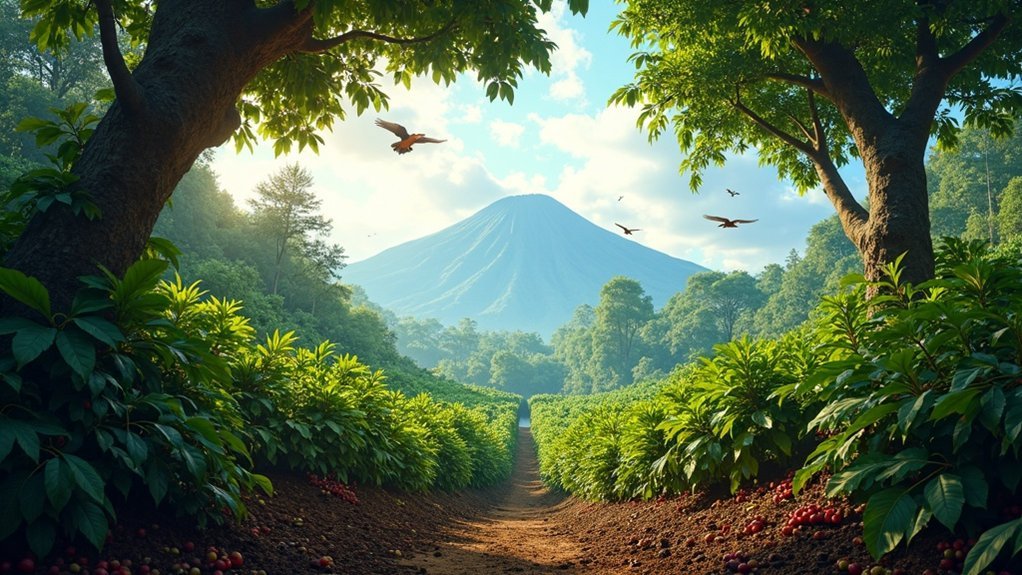
Agroforestry coffee is a sustainable farming practice that combines coffee plants with various tree species, promoting both ecological health and productivity. By integrating these diverse plants, this system not only enhances coffee yields but also improves soil quality through better moisture regulation and increased biodiversity. Additionally, agroforestry coffee supports economic stability by providing multiple sources of income and reducing reliance on chemical inputs. Transitioning to agroforestry practices does require investment, education, and a willingness to embrace new methods. Understanding these elements is essential for grasping the future of coffee cultivation and its environmental implications.
Key Takeaways
- Agroforestry coffee involves cultivating coffee plants alongside a variety of tree species, fostering ecological balance and sustainability.
- This cultivation method boosts coffee yields; for instance, regions like Apuí have reported increases from 8 to 15 bags per hectare.
- The shade provided by trees helps regulate moisture and temperature, enhances soil health, and minimizes the reliance on chemical inputs.
- Agroforestry practices promote biodiversity, which not only enhances coffee quality and flavor but also offers farmers additional income streams.
- However, transitioning to agroforestry can be challenging due to factors such as limited funding, the need for educational resources, and resistance to change within farming communities.
Definition and Importance of Agroforestry in Coffee Production
Agroforestry in coffee production, which combines coffee plants with diverse tree species, plays an essential role in enhancing ecological balance and sustainability within the coffee industry.
By integrating agroforestry practices, coffee farmers can effectively combat climate variability, maintaining productive environments even as temperatures rise. This system supports over one billion hectares globally, significantly improving carbon sequestration and local biodiversity, both crucial for coffee cultivation.
The shade provided by trees regulates moisture and temperature, enhancing soil health and the quality of coffee beans.
Shade from trees optimizes moisture and temperature, improving soil health and elevating coffee bean quality.
Furthermore, these agroforestry practices not only boost environmental resilience but also diversify income sources for coffee farmers, fostering stability in rural communities amid economic fluctuations and climate challenges.
Benefits of Agroforestry for Coffee Farms
By integrating trees into coffee farming systems, producers can significantly enhance both productivity and sustainability.
Agroforestry systems can boost coffee yields considerably; for instance, the Apuí Region Agroforestry Project demonstrated increases from 8 to 15 bags per hectare. The shade provided by trees stabilizes temperatures and promotes soil health through nitrogen fixation.
This diversification not only improves farmer livelihoods but also enhances resilience to climate change, thereby improving environmental conditions and carbon storage.
Additionally, higher biodiversity contributes to better coffee quality and flavor while reducing reliance on chemical inputs, fostering healthier ecosystems overall.
Challenges in Transitioning to Agroforestry
Transitioning to agroforestry systems in coffee cultivation presents several challenges that can hinder farmers’ efforts to adopt these sustainable practices. A significant barrier is the lack of funding, which limits the ability to move away from traditional coffee farming methods.
Educational resources are essential, as new knowledge and skills are needed to implement agroforestry effectively in coffee production. Resistance to change is common due to established habits, making it imperative to address these ingrained practices within the coffee community.
Additionally, customizing tree species and agroforestry practices for your unique coffee-growing region is necessary to ensure compatibility with local conditions. The ongoing maintenance and management, such as pruning coffee trees and managing shade plants, may also deter farmers due to perceived increases in labor demands.
Economic and Quality Advantages of Agroforestry Coffee
While many coffee farmers face numerous challenges in adopting sustainable practices, the economic and quality advantages of integrating agroforestry systems into coffee cultivation are compelling.
By implementing agroforestry, coffee producers can achieve significant increases in yields—like in the Apuí Region, where yields jumped from 8 to 15 bags per hectare. This system not only enhances flavor diversity and quality due to shaded growth conditions but also promotes economic stability through diversified income sources from additional crops.
Furthermore, certifications such as Rainforest Alliance can enhance the market value of sustainable coffee, ensuring access to premium pricing and increased consumer trust.
Future Directions and Research Needs in Agroforestry
As the coffee industry grapples with the challenges of climate change and sustainable farming practices, understanding the future directions and research needs in agroforestry is essential for the long-term viability of coffee cultivation.
The focus should be on:
- Evaluating the impact of agroforestry practices on the resilience of coffee crops and the biodiversity of associated ecosystems.
- Analyzing the cost-effectiveness and resource efficiency of these practices specifically in coffee production to enhance economic sustainability.
- Investigating the role of agroforestry in carbon sequestration, particularly how it can mitigate the climate change effects impacting coffee-growing regions.
- Developing tailored agroforestry approaches that consider the unique regional climatic and environmental conditions to ensure successful implementation in coffee farming.