Humidity barrier ratings play a crucial role in coffee storage as they indicate how well a material can prevent moisture from entering. Higher barrier ratings lead to lower moisture vapor transmission rates, helping to keep green coffee beans at their ideal moisture content of 11-12%. This protection is essential in reducing the risk of mold growth, flavor degradation, and oxidation, ultimately extending the shelf life and preserving the quality of the coffee. Understanding these ratings is key when selecting the right packaging materials and ensuring optimal storage conditions for your coffee. Learn more about how to maintain the integrity of your coffee.
Key Takeaways
- Humidity barrier ratings play a vital role in determining how well packaging materials prevent moisture penetration, which is essential for preserving the quality of coffee.
- High barrier ratings are instrumental in maintaining the optimal moisture content of green coffee beans, thereby preventing spoilage and flavor degradation.
- Packaging with lower moisture vapor transmission rates (MVTR) significantly minimizes the risk of mold growth and oxidation during storage.
- Utilizing proper packaging, such as foil-laminated bags, significantly extends the shelf life of coffee by restricting exposure to moisture and oxygen.
- Regularly monitoring storage conditions is crucial to ensure that the packaging maintains its barrier effectiveness, thus safeguarding the integrity of the coffee.
Understanding Humidity Barrier Ratings
Humidity barrier ratings are crucial for the proper storage of coffee, as they evaluate a material’s effectiveness in preventing moisture penetration.
These ratings reveal how well packaging materials resist moisture, with lower moisture vapor transmission rates (MVTR) indicating better protection.
By opting for packaging with high humidity barrier ratings, you can keep the moisture content of green coffee beans within the ideal range of 11% to 12%, reducing the chances of flavor loss and mold development.
Understanding these ratings is essential for prolonging the shelf life of your coffee, preserving its quality, and ensuring a delightful flavor experience.
The Role of Packaging in Coffee Preservation
When it comes to coffee preservation, the choice of packaging materials is critical for maintaining quality.
Understanding how different sealing techniques and humidity barrier ratings affect moisture control and flavor retention is essential.
Packaging Materials Impact
Effective packaging materials play an essential role in preserving coffee quality, as they greatly influence the beans’ exposure to moisture and oxygen. High barrier ratings in packaging help maintain the ideal moisture content of green coffee beans. Options like hermetic packaging and foil-laminated bags considerably reduce humidity levels and oxidation risk, ensuring that your coffee stays fresh and flavorful.
| Packaging Type | Key Benefits |
|---|---|
| GrainPro® Bags | Prevents moisture ingress |
| Vacuum-Sealed | Enhances longevity and flavor |
| Nitrogen-Flushed | Maintains freshness over time |
Regular monitoring of storage conditions is vital to guarantee these materials perform effectively, allowing you to enjoy the best coffee experience possible.
Sealing Techniques Importance
Sealing techniques are essential for preserving the quality of coffee, as they significantly affect how the beans are protected from moisture and oxygen. Effective humidity control depends on proper sealing methods, such as hermetic or vacuum-sealed options, which prevent moisture ingress and oxidation.
Using airtight containers minimizes air exchange, helping to maintain moisture levels and the coffee’s original aroma. Nitrogen-flushed packaging further reduces oxidation by replacing oxygen with inert nitrogen gas, thus extending the shelf life of your coffee.
It’s crucial to regularly check the integrity of the packaging; any compromised seals can allow humidity to enter, potentially leading to microbial growth and jeopardizing the quality of your stored coffee.
Barrier Ratings Explained
Barrier ratings are crucial for maintaining the quality of coffee, as they measure how effectively packaging materials shield against moisture and oxygen infiltration.
High-barrier materials, such as foil-laminated bags, significantly reduce moisture transmission, helping green coffee maintain its optimal moisture content of 11% to 12%. This protection is vital in preventing humidity fluctuations that can compromise coffee quality.
Furthermore, efficient packaging limits oxygen exposure, thereby minimizing the risk of rancidity and flavor deterioration.
Regular assessment of barrier ratings is essential for coffee producers, as inadequate packaging can result in elevated moisture levels, mold growth, and a general decline in the quality of stored coffee.
How Humidity Affects Coffee Quality
Humidity plays a critical role in determining the quality of coffee, as both high and low moisture levels can lead to undesirable outcomes.
Consider the following effects of humidity on your coffee:
- High humidity can cause mold growth, leading to off-flavors in your brew.
- Excess moisture can lead to microbial growth and oxidation, spoiling your precious beans.
- Low humidity can dry out the beans, dulling the rich flavor profiles you expect from quality coffee.
- The ideal moisture content for green beans is between 11% and 12% to ensure optimal taste.
Maintaining relative humidity between 50% and 60% is crucial for flavor retention and stability during storage.
Continuous monitoring of humidity levels guarantees that your coffee remains fresh and of the highest quality for your enjoyment.
The Science Behind Water Activity in Coffee
Understanding water activity is essential for maintaining the quality of coffee, as it directly influences both flavor and safety. Water activity (aw) measures the availability of free water, with levels above 0.65 posing a risk for microbial growth. Most microorganisms thrive between 0.77 and 0.85 aw, highlighting the importance of proper storage conditions. Elevated water activity also speeds up lipid oxidation, leading to undesirable off-flavors. To ensure both microbial safety and chemical stability, aim for an optimal storage aw of 0.55 to 0.65.
| Water Activity Level | Effect on Coffee Quality |
|---|---|
| Below 0.55 | Safe, stable storage |
| 0.55 – 0.65 | Ideal for flavor retention |
| 0.65 – 0.77 | Increased spoilage risk |
| Above 0.77 | High risk of microbial growth |
Selecting the Right Packaging for Green Coffee
Proper storage of green coffee is as crucial as controlling water activity, and selecting the right packaging is essential for maintaining quality.
When choosing your packaging materials, consider the following factors:
- Opt for high-barrier moisture-proof options like GrainPro® bags or foil-laminated bags to protect the freshness of your coffee.
- Ensure the packaging maintains humidity levels within the ideal range of 50-60% to preserve flavor and aroma.
- Utilize vacuum or nitrogen-flushed bags to improve barriers against moisture and oxygen, keeping your coffee in optimal condition.
- Regularly monitor barrier ratings to ensure maximum protection against moisture transmission, safeguarding the quality of your green coffee.
Impact of Humidity Barrier Ratings on Shelf Life
Understanding humidity barrier ratings is essential for maximizing the shelf life of your coffee.
A comparison of barrier performance reveals significant differences in moisture control, which directly influences the quality of the beans.
Barrier Performance Comparison
When selecting packaging for coffee storage, evaluating humidity barrier ratings is essential, as they significantly influence the shelf life of the product.
Here are some key points to consider:
- Higher humidity barrier ratings effectively prevent moisture ingress.
- Foil-laminated and GrainPro® bags help maintain the ideal moisture content (11-12%).
- Lower water vapor transmission rates (WVTR) indicate superior moisture resistance.
- Effective barriers keep water activity (aw) within the critical range (0.55-0.65).
These factors are vital in preventing spoilage and flavor degradation, ensuring that your coffee stays fresh for a longer period.
Therefore, choosing the right packaging materials is crucial for preserving quality and extending shelf life.
Effects on Bean Quality
The effectiveness of packaging in maintaining humidity barrier ratings is crucial for preserving the quality of coffee beans. High humidity barrier ratings ensure that moisture levels remain between 11% and 12%, which is essential to prevent excess moisture that can lead to mold growth and spoilage.
This stable environment helps to maintain the flavor integrity of your coffee, particularly in the complex profiles of green coffee. On the other hand, low barrier ratings allow moisture to seep in, which accelerates lipid oxidation and can result in undesirable off-flavors.
Best Practices for Storing Coffee
To ensure your coffee retains its rich flavor and quality, it’s essential to store it under optimal conditions.
Follow these best practices for ideal coffee storage:
- Use high-barrier moisture-proof packaging, such as GrainPro® bags, to protect your coffee.
- Maintain humidity levels between 50% and 60% to prevent moisture absorption, which can compromise flavor.
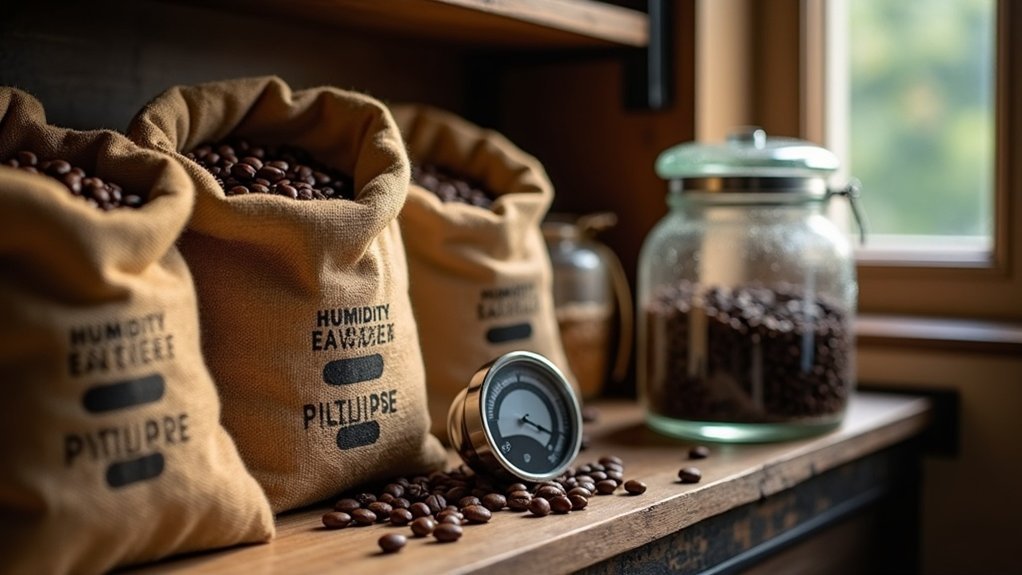
- Regularly monitor humidity with hygrometers to ensure a stable storage environment.
- Utilize desiccant-based dehumidifiers to effectively control any excessive humidity.
Innovations in Humidity Control Solutions
As advancements in humidity control solutions emerge, coffee storage practices are evolving to ensure maximum flavor preservation and quality.
Innovative packaging materials, such as GrainPro® bags and foil-laminated options, reduce moisture ingress, protecting coffee from environmental fluctuations.
Innovative packaging like GrainPro® bags effectively shields coffee from moisture, ensuring flavor integrity amid environmental changes.
Humidity control systems, like desiccant-based dehumidifiers, maintain ideal moisture levels in storage facilities, ensuring that beans remain below the critical 12% moisture threshold.
Continuous monitoring technologies, including hygrometers, provide real-time data on humidity levels, allowing for precise adjustments to minimize spoilage risks.
Nitrogen-flushed packaging further enhances barriers against humidity, maintaining stable relative humidity levels between 50% and 60% to prevent mold growth and guarantee the quality of your coffee.