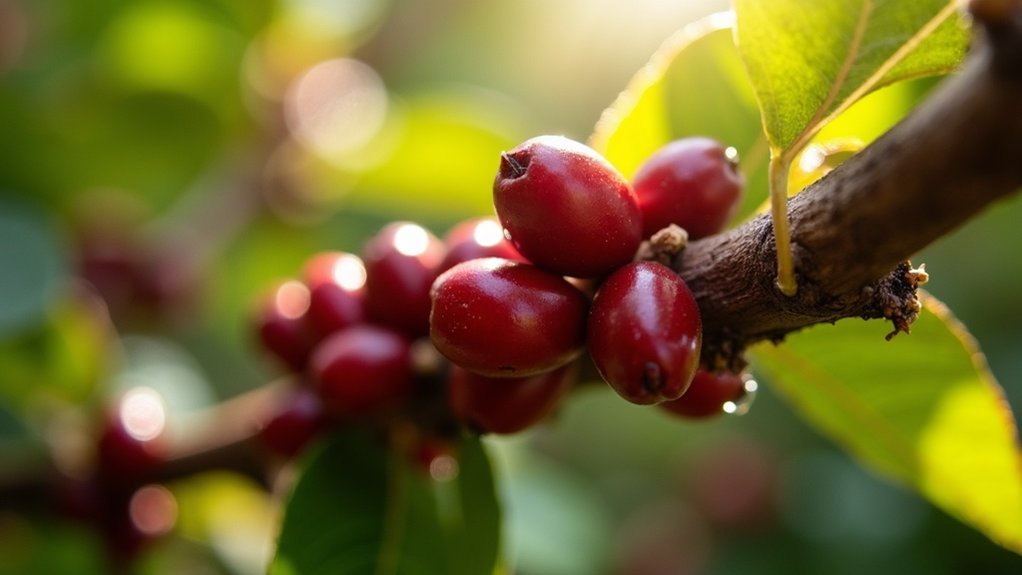
Typica coffee is a highly regarded Arabica varietal that traces its roots back to Ethiopia. It is celebrated for its distinctive flavor profile, which encompasses nutty, floral, and fruity notes. This varietal flourishes at high altitudes and requires specific growing conditions to reach its full potential. While Typica offers a rich and complex flavor experience, it is also vulnerable to diseases such as coffee leaf rust, which can impact its overall yield. The beans of Typica are typically larger and more elongated than those of other coffee varieties. Additionally, exploring its cultivars and hybrids can provide further insight into the unique characteristics of this classic coffee.
Key Takeaways
- Typica coffee originated in Ethiopia and has since spread worldwide, becoming a prominent Arabica variety in the Americas by the late 1700s.
- This varietal is known for its tall growth, distinctive bronze leaf tips, and larger, elongated beans compared to Bourbon.
- Typica flourishes in high-altitude environments (3000-4000 meters) and requires medium levels of nutrition to achieve optimal quality.
- Its flavor profile features nutty, floral, and fruity notes, which can vary based on origin and roasting methods.
- Typica serves as the parent for several hybrids, including Bourbon and Caturra, which are developed to enhance yield and disease resistance.
A Brief History of Typica Coffee
Typica coffee has a fascinating lineage that traces back to southwestern Ethiopia, where its seeds were first cultivated.
Transported to Yemen in the 15th and 16th centuries, Typica made its way to India and, later, to Europe, greatly impacting the global coffee landscape.
French traders expanded its reach along colonial trade routes, introducing it to Central and South America, Jamaica, Cuba, and the Dominican Republic.
By the late 1700s, Typica became the dominant arabica variety in the Americas, influencing many other varieties.
However, its cultivation has declined due to low yield and high susceptibility to diseases compared to more resilient options.
Characteristics of Typica Coffee
When you explore the characteristics of Typica coffee, you’ll notice its tall growth habit and unique bronze leaf tips, which set it apart from other varieties in the field.
Typica beans are larger and more elongated than those of Bourbon, offering a clean, complex flavor profile cherished by coffee enthusiasts. However, its low yield potential makes cultivation challenging, requiring medium nutrition and ideal high-altitude conditions for high-quality results.
Additionally, Typica is particularly susceptible to diseases like coffee leaf rust, which can impact coffee production and commercial viability.
This varietal’s rich lineage also greatly influences many Arabica coffee varieties around the globe, making it a significant focus for coffee lovers and producers alike.
Tasting Notes and Roasting Tips
While exploring the tasting notes of Typica coffee, you’ll discover a clean and complex flavor profile that often includes nutty, floral, and fruity undertones, varying considerably based on its origin.
To achieve high-quality results, pay attention to the bean density and moisture content during roasting. Proper airflow is essential to avoid undesirable flavors.
Due to Typica’s elongated beans, you may need to adjust roasting times compared to rounder varieties like Bourbon.
Remember that Typica’s susceptibility to diseases and lower yield requires skilled techniques to maximize its potential while preserving the intricate flavor notes that make Typica so unique.
Enjoy your journey into the world of coffee!
Typica Cultivars and Hybrids
When you explore Typica cultivars and hybrids, you’ll discover a captivating variety of flavor profiles and enhancements in yield.
For instance, hybrids like Mundo Novo demonstrate how crossbreeding with other varieties can boost productivity while maintaining the cherished attributes of Typica.
Moreover, cultivars such as Maragogipe and Jamaica Blue Mountain emphasize the richness within Typica, each providing distinct qualities that appeal to various preferences among coffee lovers.
Notable Typica Hybrids
Typica hybrids represent a fascinating evolution in coffee cultivation, blending the traditional qualities of Typica with the advantages of other cultivars to enhance coffee production and flavor. Notable examples include Pacamara, which features larger cherries and variable disease resistance, and Acaia, a hybrid of Sumatra and Bourbon that improves productivity while maintaining Typica’s distinctive flavor profile. Macaturra, resulting from the cross of Maragogipe and Caturra, is recognized for its unique adaptability. Mundo Novo, a combination of Sumatra and Bourbon, offers higher yields compared to traditional Typica varieties.
| Hybrid | Key Traits |
|---|---|
| Pacamara | Large cherries, disease resistance |
| Acaia | Improved productivity, flavor preservation |
| Macaturra | Unique characteristics, adaptability |
| Mundo Novo | Higher yields, disease resistance |
Yield Improvements
Although traditional Typica coffee is cherished for its flavor profile, its low yield potential often leads growers to seek out more productive options.
- Maragogipe produces larger cherries but lower quantities, making it less favorable for commercial production.
- Cross-bred hybrids like Mundo Novo and Pacamara are developed to enhance yield without compromising on taste.
- Some hybrids successfully retain Typica’s beloved flavor characteristics while increasing overall production.
- Improved disease resistance is a key feature of modern hybrids, ensuring healthier crops and better yields.
The evolution of Typica cultivars aims to strike a balance between maintaining exceptional flavor quality and achieving greater productivity for coffee growers.
Flavor Profile Variations
The quest for improved yield in Typica coffee has led to the development of various cultivars and hybrids, each showcasing unique flavor profile variations. These flavor differences are influenced by their distinct growing conditions and roasting techniques, enhancing the overall coffee experience for enthusiasts.
| Typica Cultivar | Flavor Profile |
|---|---|
| Jamaica Blue Mountain | Mild with nutty and chocolate notes |
| Indonesian Typica | Nutty, floral, fruity, and vegetal tones |
| Maragogipe | Larger cherries with nuanced flavors |
| Typica Hybrids | Diverse, high-quality characteristics |
| Other Arabica Varieties | Sweet, complex, with varying undertones |
These diverse flavor variations ensure that coffee lovers can explore a wide range of experiences within the Typica family.
Agronomic Details and Disease Resistance
Understanding the growth habit of Typica coffee plants is essential for coffee cultivation, as their tall structure and specific planting density requirements directly impact overall yield.
These plants thrive in high-altitude conditions with medium nutrition, but their low yield potential and late fruiting can pose challenges for coffee growers.
Additionally, Typica coffee plants are susceptible to diseases such as coffee leaf rust and nematodes, necessitating vigilant management strategies to ensure successful coffee production.
Growth Habit Characteristics
While Typica coffee plants are distinguished by their tall growth habit and large beans, their agronomic characteristics present both opportunities and challenges for growers.
Here are some key points to consider:
- Ideally, 3000-4000 plants are needed per hectare for optimal growth.
- The yield potential is low, with cherries taking about four years to mature.
- These plants thrive at high altitudes, which enhances the quality of the coffee produced.
- They’re susceptible to diseases such as coffee leaf rust and coffee berry disease.
- Successful cultivation requires careful management and ongoing monitoring.
Understanding these growth habit characteristics is essential for making informed decisions when cultivating Typica coffee.
Disease Resistance Overview
Although Typica coffee is highly regarded for its exceptional flavor profile, it faces significant challenges for growers due to its low resistance to diseases. This varietal is particularly susceptible to major issues such as coffee leaf rust, nematodes, and coffee berry disease.
Consequently, its yield potential is generally lower when compared to more resilient varieties like Bourbon. Continuous monitoring of disease resistance is crucial, as Typica’s vulnerabilities may change over time.
While growing at high altitudes can help alleviate some problems, the primary focus remains on preserving the quality of coffee despite these challenges. Understanding and managing these risks is essential for successful Typica cultivation.
Optimal Cultivation Conditions
Given Typica coffee’s susceptibility to diseases, ideal cultivation conditions become essential for mitigating these risks and enhancing overall yield.
To optimize your Typica coffee cultivation:
- Grow at high altitudes (3000-4000 meters)
- Implement single-stem pruning for better management
- Monitor nutrition levels to meet medium requirements
- Use integrated pest management to combat coffee leaf rust
- Focus on practices that enhance cup quality
Related Coffee Varieties
The Typica coffee varietal is intricately connected to several other notable varieties that share its lineage and characteristics. These related varieties often exhibit high-quality cup profiles and address challenges like coffee leaf rust.
| Coffee Variety | Characteristics | Relation to Typica |
|---|---|---|
| Bourbon | Sweet, complex flavor; susceptible | Direct descendant |
| SL34 | Hardy in extreme climates; high yield | Bourbon-type variant |
| Caturra | Compact growth; disease-resistant | Typica mutation |
| Java | Moderate yield; good disease resistance | Suspected progeny |
Understanding these relationships enhances your appreciation for Typica and its impact on coffee quality.