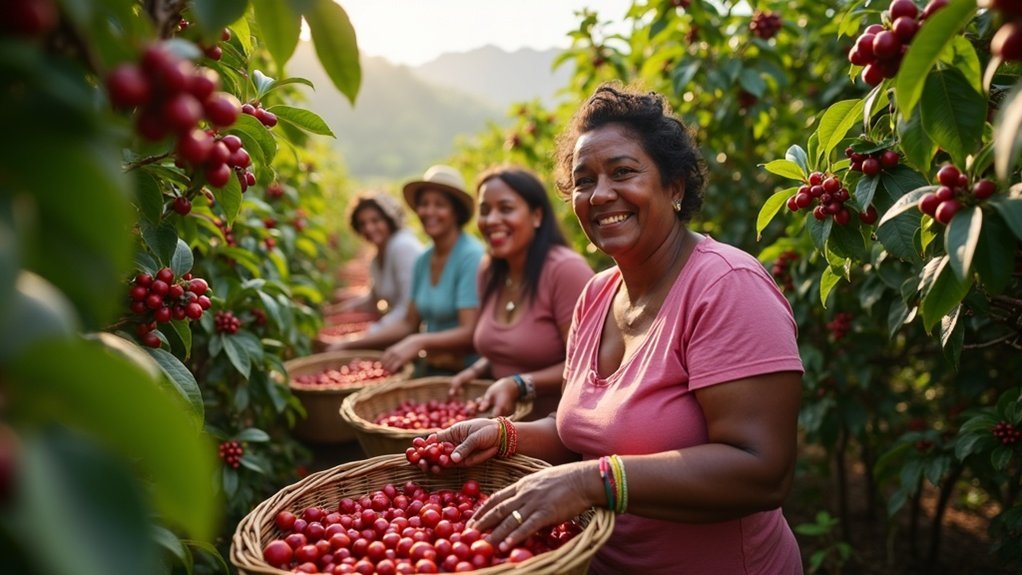
Women-produced coffee refers to coffee cultivated, harvested, and processed by female farmers, who constitute about 70% of the workforce in the coffee industry. These women often encounter significant challenges, including limited land ownership and unequal pay. Despite their vital contributions, their work frequently goes unrecognized. Empowering these women is essential for sustainable development in coffee farming, fostering economic independence and community growth. To delve deeper into the broader impact of women in the coffee sector, continue exploring this topic.
Key Takeaways
- Women-produced coffee refers to coffee sourced primarily from female farmers, underscoring their essential contributions to the coffee industry.
- Around 70% of coffee farmers globally are women, yet their efforts often go unrecognized and undercompensated.
- Initiatives like Café Femenino are dedicated to empowering women and ensuring fair pay for their work in coffee production.
- Supporting women farmers not only improves household welfare but also promotes broader economic growth within their communities.
- The coffee industry’s future looks toward a significant increase in sourcing nearly 100% women-produced coffee alongside sustainable practices.
The Role of Women in Coffee Production
While many people enjoy their daily cup of coffee, they mightn’t realize that women play an essential role in its production. Women account for about 70% of coffee farmers worldwide, yet their contributions often go unrecognized and underpaid.
This disparity extends to land ownership, where women represent only 3-20% of landowners in developing countries. Consequently, many rely on male family members for financial support, which limits their independence.
Initiatives like Café Femenino aim to empower women coffee producers, ensuring they receive fair compensation and recognition for their work. Investing in women not only uplifts them but also strengthens coffee-producing communities through better education and welfare outcomes.
Challenges and Inequities Faced by Female Farmers
Despite their significant contributions to coffee production, female farmers face numerous challenges that hinder their progress and economic stability within the coffee industry. Women producers make up about 70% of the labor force, yet they encounter systemic barriers limiting their access to land, credit, and resources vital for coffee cultivation.
With ownership rates as low as 3-20%, economic inequities in coffee farming become starkly evident. Even when women own land, they often earn less than men for similar work in the coffee sector, perpetuating the gender pay gap.
Many resort to discreetly selling coffee for financial autonomy, risking domestic disputes and complicating their already precarious economic situations. Empowering these women in coffee farming is essential for sustainable development within the industry.
The Importance of Fair Compensation
Why is fair compensation essential for women in coffee production? Women make up about 70% of the labor force in this industry but often earn less than their male counterparts for similar roles.
This wage gap restricts their financial independence and limits their access to vital resources, as they typically control only 3-20% of land ownership. Many women rely on male family members for financial support, which further diminishes their economic power.
Initiatives Empowering Women in Coffee
As initiatives aimed at empowering women in coffee production gain momentum, they’re transforming not only the lives of individual farmers but also the entire coffee industry.
The Café Femenino program, established in 2004, ensures that women coffee producers receive fair compensation and recognition for their work.
Similarly, the Women Coffee Producers program from Café Imports highlights female visibility and advocates for equitable pay in the coffee sector.
These organizations provide essential resources, education, and training, helping women overcome barriers such as land ownership.
Economic Impact of Investing in Women
Investing in women within the coffee industry can transform entire communities, boosting household welfare and fostering economic independence.
When women reinvest their earnings from coffee production into family needs, you’ll see not just improved nutrition but also enhanced educational opportunities for the next generation.
Ultimately, empowering women in the coffee sector leads to stronger local economies and greater community development, creating a ripple effect that benefits everyone involved in the coffee supply chain.
Community Development Benefits
When communities prioritize economic empowerment for women in the coffee industry, they unlock a multitude of benefits that extend beyond individual households.
Here are three key advantages specifically related to coffee:
- Women reinvest nearly all their agricultural income from coffee sales into their families, significantly enhancing nutrition and education.
- Increased decision-making power for women in the coffee sector correlates positively with community development investments, fostering growth and sustainability.
- Women’s income from coffee production boosts local economies and supports overall community welfare, creating a thriving environment for all.
Improved Household Welfare
Empowering women in the coffee industry directly enhances household welfare, creating a ripple effect that benefits entire communities.
When women make decisions about coffee-related income, they often reinvest nearly all of it into essential family needs like education and nutrition. This investment leads to better health outcomes and improved food security in households led by women.
Despite making up about 70% of the coffee labor force, women receive less compensation, highlighting the need for equitable investments within the coffee sector.
Enhanced Economic Independence
While the coffee industry flourishes thanks to the dedication of women producers, their economic independence is often hindered by systemic barriers.
Investing in women farmers can lead to significant advantages in the coffee sector, including:
- Improved nutrition and education for families, as women reinvest nearly all their income back into their households.
- Enhanced community welfare, since women tend to prioritize household needs over personal gain, leading to stronger local economies.
- Increased productivity and sustainable growth driven by women’s decision-making power in agricultural practices, which can lead to higher quality coffee production.
Empowering women in coffee production not only transforms their lives but also strengthens community resilience.
This highlights the importance of fostering economic independence for women, which is essential for a flourishing coffee industry.
Building Community Through Women-Led Farms
Women-led farms are transforming the coffee industry by fostering sustainable practices that not only improve coffee quality but also enhance social connections among farmers.
Through initiatives supported by the Café Femenino Foundation, these women empower themselves economically, taking on leadership roles and actively participating in community development.
Women are harnessing economic empowerment and leadership to drive community development through initiatives by the Café Femenino Foundation.
By creating networks for collaboration and resource sharing, they strengthen their farming communities’ resilience. The economic independence gained allows them to invest in education, healthcare, and infrastructure, benefiting everyone.
As recognition for their contributions grows, women in coffee are increasingly seen as essential to achieving broader community goals, showcasing the power of women in the coffee sector.
Future Trends for Women in the Coffee Industry
As the coffee industry evolves, a remarkable shift towards supporting female farmers is becoming increasingly evident, reshaping the landscape for women in this field.
Future trends to expect include:
- Increased sourcing of nearly 100% women-produced coffee, which will highlight the vital contributions of female farmers.
- Adoption of sustainable farming practices by women-led farms, leading to enhanced quality in specialty coffee.
- Expansion of empowerment initiatives that provide leadership roles and market opportunities for female producers.
These shifts, along with policies advocating for gender equality, are paving the way for a more inclusive coffee industry, inspiring the next generation of women coffee producers and celebrating their achievements.