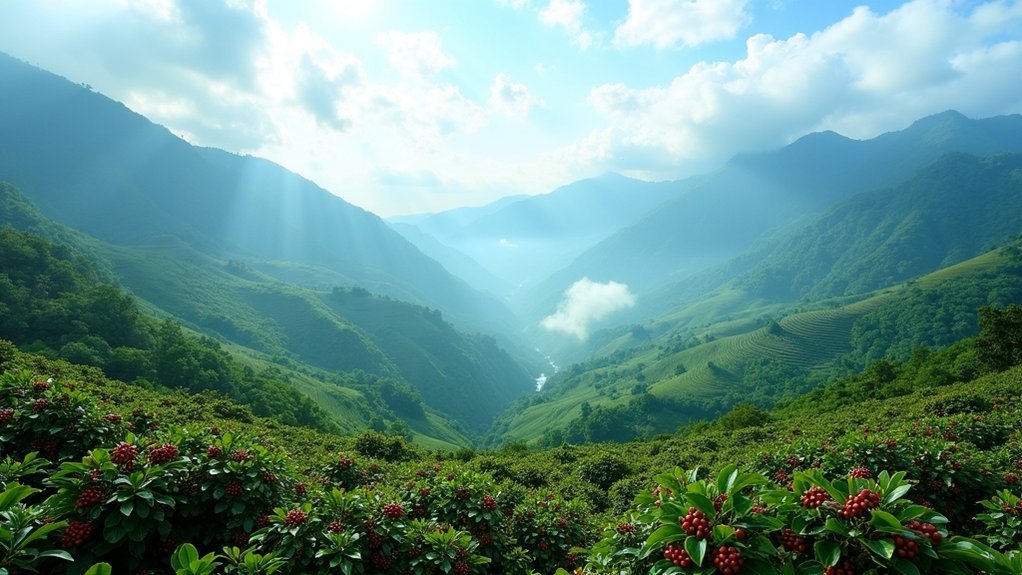
Chinese Yunnan coffee primarily grows in Yunnan province, which produces over 90% of the nation’s coffee. Key regions include Dehong, Baoshan, Lincang, and Pu’er City, where unique microclimates enhance flavor profiles. Dehong coffee features floral and cereal notes, while Baoshan offers nutty and chocolate flavors. Lincang’s bright citrus notes reflect its ideal growing conditions. These areas benefit from rich volcanic soil and altitude variations, which contribute significantly to the beans’ quality and taste. Discover the diverse offerings of Yunnan coffee and experience its unique flavors.
Key Takeaways
- Yunnan province is the primary area for coffee production in China, contributing over 90% of the country’s output, making it a significant player in the global coffee industry.
- The major coffee-growing regions in Yunnan include Dehong, Baoshan, Lincang, and Pu’er City, each offering unique flavor profiles.
- Dehong Prefecture’s tropical climate produces beans with floral and cereal notes, appealing to those who enjoy complex flavors in their cup.
- Baoshan City is renowned for its Lujiangba coffee, characterized by nutty, chocolate, and smoky flavors, perfect for those seeking a rich and robust experience.
- Lincang stands out for its specialty coffee, known for bright citrus flavors, which thrive due to the region’s high altitude and favorable climate conditions, making it a favorite among coffee connoisseurs.
Key Coffee-Producing Regions in Yunnan
Yunnan province stands as the cornerstone of China’s coffee production, contributing over 90% of the nation’s yield. Key regions like Dehong, Baoshan, Lincang, and Pu’er City play pivotal roles in this success.
Dehong Prefecture, with its tropical rainforest climate and altitudes over 1000 meters, produces beans with floral and cereal notes, making it a favorite among coffee connoisseurs. In Baoshan City, the renowned Lujiangba coffee is celebrated for its nutty, chocolate, and smoky flavors, appealing to a wide range of palates.
Lincang is recognized for its specialty coffee, which mirrors Colombia’s climate, yielding bright citrus flavors in light roasts that are perfect for those who enjoy a refreshing brew.
Pu’er City, essential since 1988, exports coffee with unique aromas and strong, pleasantly sour flavors to over 30 countries, showcasing the diverse offerings of Yunnan’s coffee landscape.
Flavor Profiles of Yunnan Coffee
Coffee from Yunnan offers a remarkable diversity of flavor profiles, reflecting the distinct climates and altitudes of its key regions.
Yunnan coffee showcases a unique array of flavors, shaped by its varied climates and altitudes.
In Dehong Prefecture, you’ll discover floral and cereal-like flavors, enhanced by its tropical rainforest climate.
Baoshan City’s coffee varieties showcase nutty, chocolate, and smoky notes, particularly with the acclaimed Lujiangba coffee.
Lincang City provides light roasts with bright citrus flavors, while medium roasts reveal fruity characteristics, reminiscent of Colombia’s coffee profile.
Particularly, Pu’er City’s coffee stands out with a strong aroma, pleasant sourness, and vibrant fruity acidity, exemplifying the rich flavor profiles unique to Yunnan’s terroir.
Ideal Growing Conditions and Terroir
Nestled within a unique geographical setting, the ideal growing conditions for coffee in Yunnan stem from its fertile volcanic soil, which enhances the natural sweetness and clarity of the beans.
Significant temperature variations—cold nights paired with sub-tropical afternoons—are essential for the slow maturation of coffee cherries.
Altitudes between 1,000 to 2,000 meters further amplify flavor complexity, allowing for diverse profiles.
The region’s rich plant life and high humidity levels optimize coffee cultivation, ensuring the growth of high-quality Arabica beans.
Areas like Lincang, Baoshan, and Pu’er beautifully showcase this remarkable terroir, making them prime locations for exceptional coffee production.
Historical Context of Coffee Cultivation
Since the introduction of coffee seeds to the region by a French missionary in 1892, Yunnan has developed a rich historical context for coffee cultivation that considerably shapes its current status in the global market.
Large-scale coffee planting began in 1952, dramatically increasing the cultivation area from 4,000 hectares to 7,800 hectares by 1997. The late 20th century marked a turning point with a government initiative in 1988, enhancing modern practices.
Today, Yunnan accounts for 70% of China’s coffee planting area and 83% of its output, solidifying its role as the leading coffee production region in the country.
Notable Coffee Varieties From Yunnan
In Yunnan, you’ll discover a rich variety of coffee, primarily focusing on Arabica cultivars like Catimor, known for its resilience in local growing conditions.
Additionally, the Typica and Bourbon varieties add distinctive flavor profiles to the region’s offerings. Typica is celebrated for its fruity aromas and well-balanced taste, while Bourbon enhances this complexity with sweet and rounded notes.
Understanding these characteristics can significantly enhance your appreciation for the diverse and exquisite offerings of Yunnan coffee.
Typica Coffee Characteristics
Typica coffee stands out among Yunnan’s notable varieties due to its distinct characteristics and cultivation conditions.
Grown at altitudes between 1,200 to 2,000 meters, Yunnan produces Typica coffee that boasts balanced acidity and a rich flavor profile.
The region’s volcanic soil, combined with the cool nights and warm sub-tropical afternoons, enhances the cherries’ aromatic qualities.
You’ll often notice its floral aroma and fruity notes, reflecting Yunnan’s diverse microclimates.
Farmers in Yunnan employ both traditional and modern cultivation techniques, emphasizing quality and sustainability, ensuring that Typica coffee retains its desirable attributes throughout the growing process.
Bourbon Coffee Profile
Bourbon coffee is a remarkable variety cultivated in Yunnan, known for its sweet and intricate flavor profile. It features enticing notes of chocolate and caramel, which are a result of its high-altitude cultivation.
The cooler temperatures and nutrient-rich volcanic soil in Yunnan significantly contribute to the development of these distinctive characteristics. Although Bourbon coffee plants yield less compared to other varieties, making them a specialty choice, this factor also adds to their premium pricing.
Yunnan’s coffee farming practices prioritize quality over quantity, aligning with sustainable methods that further enhance Bourbon coffee’s reputation in specialty competitions, showcasing its potential in the global coffee market.
Catimor Coffee Resilience
While exploring remarkable coffee varieties from Yunnan, you’ll find Catimor stands out due to its extraordinary resilience and adaptability.
This hybrid, introduced in 1991, combines the hardiness of Timor with the quality of Caturra, enabling it to thrive in Yunnan’s volcanic soil and diverse climate. Its substantial resistance to diseases like coffee leaf rust guarantees sustainable production, which is vital for local coffee farmers.
Catimor coffee plants yield beans within 3-4 years, contributing significantly to Yunnan’s coffee output. With a flavor profile balancing fruity and floral notes, Catimor appeals to both local and international coffee markets, solidifying its importance in Yunnan’s coffee landscape.
Sustainable Farming Practices in Yunnan
In Yunnan, you’re witnessing a shift toward sustainable coffee farming practices that prioritize environmental conservation techniques, such as shade-grown coffee cultivation.
Training programs for farmers are increasingly focusing on organic certification practices, which not only enhance coffee quality but also align with global trends in consumer preferences.
These initiatives ensure that your coffee not only tastes good but is also produced responsibly, supporting both the ecosystem and local communities.
Environmental Conservation Techniques
As sustainable farming practices gain traction in Yunnan, coffee farmers are increasingly turning to organic methods that not only enhance the quality of their beans but also protect the local environment.
By utilizing shade-grown coffee, they help preserve forest ecology while improving the flavor profiles of their coffee. Traditional hand-picking techniques ensure that only the ripest cherries are harvested, minimizing environmental impact compared to mechanized methods.
Multi-year agreements with companies like Yunnan Coffee Traders foster long-term commitments to environmental conservation. This focus on quality over quantity encourages practices that enhance soil health and biodiversity, reflecting a growing awareness of sustainability within the coffee industry.
Farmer Training Programs
Sustainable coffee farming practices in Yunnan are significantly enhanced by farmer training programs that focus on improving coffee quality while minimizing ecological impacts.
These programs, often backed by long-term agreements with organizations like Yunnan Coffee Traders, provide vital knowledge on coffee crop management, pest control, and water conservation.
By promoting sustainable methods, such as shade-grown coffee cultivation, these initiatives help maintain forest ecosystems and elevate the natural flavors of the beans.
As coffee farmers implement these techniques, they not only boost their yields but also gain recognition in both domestic and international markets, ultimately expanding market opportunities for local coffee producers.
Organic Certification Practices
While many farmers in Yunnan embrace organic certification practices to meet the increasing demand for sustainably produced coffee, this shift involves significant changes in farming methods.
Organic certification focuses on environmentally friendly practices, such as avoiding synthetic fertilizers and pesticides, which promotes soil health and biodiversity essential for sustainable coffee cultivation.
Farmers are adopting shade-grown coffee cultivation, which not only preserves forest ecosystems but also enhances the flavor profiles of the coffee beans.
The certification process demands rigorous inspections to ensure compliance with organic standards.
Organizations like Yunnan Coffee Traders support these initiatives, emphasizing long-term commitments to sustainable coffee production practices, fostering a healthier environment for future generations of coffee lovers.
The Role of Cooperatives in Coffee Production
Cooperatives play a pivotal role in Yunnan’s coffee production, significantly impacting the livelihoods of smallholder farmers and the overall quality of the coffee produced.
By providing essential resources, training, and access to better markets, these cooperatives empower farmers to adopt sustainable practices. They foster long-term relationships, ensuring knowledge transfer that enhances coffee quality.
By pooling resources, cooperatives enable economies of scale, which reduces costs and improves farmers’ bargaining power. Many cooperatives focus on specialty coffee, which opens up higher-value markets and increases farmers’ incomes.
Additionally, they promote transparency in pricing and quality, building trust between farmers and buyers—an essential component for a resilient coffee supply chain.