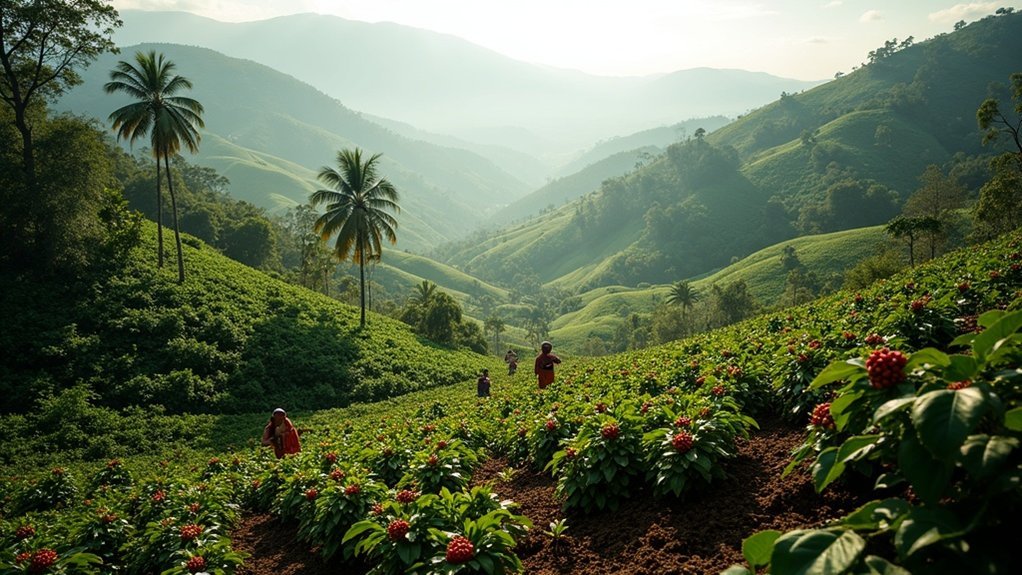
Salvadoran coffee primarily grows in several regions, with the Apaneca-Ilamatepec Mountain Range leading at 60-65% of production. This region’s high elevations and rich volcanic soils create distinct flavors that coffee enthusiasts appreciate. Other key areas include the Central Belt and the Tecapa-Chinchontepec Mountain Range, each contributing unique characteristics to the coffee profile. Sustainable practices and community support play a critical role in the cultivation of Salvadoran coffee, ensuring its quality and helping local farmers thrive. For a deeper understanding of the unique traits and challenges of Salvadoran coffee, you’ll want to explore further into its rich history and cultivation methods.
Key Takeaways
- Salvadoran coffee primarily grows in the Apaneca-Ilamatepec region, which accounts for 60-65% of the country’s production, making it a vital area for coffee enthusiasts.
- Other significant growing areas include the Central Belt and Tecapa-Chinchontepec Mountain Range, both of which contribute to the diverse flavor profiles of Salvadoran coffee.
- The Cacahuatique Mountain Range is renowned for its Bourbon and Pacas coffee varietals, prized for their unique taste and quality.
- High-quality Pacamara coffee is produced in the Alotepeque-Metapan region, benefiting from the rich volcanic soils that enhance its flavor.
- Coffee cultivation occurs at elevations ranging from 500 to 2,365 meters, which significantly enhances the flavor profiles and aromas of the beans, making Salvadoran coffee a favorite among connoisseurs.
Overview of Coffee Growing Regions in El Salvador
When you explore the coffee-growing regions of El Salvador, you’ll discover a rich and diverse landscape that significantly influences the flavor and quality of its beans.
The Apaneca-Ilamatepec region, which accounts for 60-65% of the country’s coffee production, is celebrated for its high altitude and fertile volcanic soil, creating ideal conditions for coffee cultivation.
The Apaneca-Ilamatepec region, known for its high altitude and volcanic soil, produces 60-65% of El Salvador’s coffee.
Furthermore, the Central Belt and Tecapa-Chinchontepec Mountain Range provide an excellent environment for growing coffee, with elevations ranging from 500 to 2,000 meters above sea level.
The Cacahuatique Mountain Range is particularly noted for its Bourbon and Pacas varieties, while the Alotepeque-Metapan region specializes in producing high-quality Pacamara coffee from small, dedicated farms.
Collectively, these regions are instrumental in shaping El Salvador’s coffee industry.
The Apaneca-Ilamatepec Mountain Range
The Apaneca-Ilamatepec Mountain Range plays an essential role in Salvadoran coffee production, thanks to its diverse geography and elevation.
This region is renowned for its sought-after coffee varietals like Bourbon, Pacamara, and Geisha, all thriving in nutrient-rich volcanic soils.
Moreover, the commitment to sustainable farming practices in this area ensures that coffee cultivation supports biodiversity, enhancing the rich flavor profiles that coffee aficionados cherish.
Geographic Characteristics
Nestled in western El Salvador, the Apaneca-Ilamatepec Mountain Range is home to some of the country’s finest coffee-growing regions. The area features altitudes ranging from 500 to 2,365 meters, which, combined with the rich volcanic soils, significantly enhance the flavor profile of its coffee.
Here, you’ll primarily find Arabica coffee varietals, including the celebrated Bourbon and Pacamara, known for their exceptional taste and aroma.
- Rich volcanic soils elevate coffee quality
- Varied altitudes contribute to distinct flavor profiles
- Arabica varietals offer unparalleled aroma and taste
- Certified under the Denomination of Origin for authenticity
These geographic characteristics make the Apaneca-Ilamatepec Mountain Range an ideal location for cultivating high-quality coffee.
2. Coffee Varietals Grown
With its ideal growing conditions, the Apaneca-Ilamatepec Mountain Range produces an impressive array of coffee varietals. Key varietals include Bourbon, known for its sweetness and complexity, along with Pacamara and Pacas.
This region is responsible for approximately 60–65% of El Salvador’s coffee production, making it vital to the industry. The unique microclimates in this area foster diverse flavor profiles, showcasing floral, fruity, and chocolate notes that appeal to specialty coffee enthusiasts.
Additionally, shade-grown practices enhance biodiversity and promote sustainable agriculture, ensuring high-quality coffee production. The rich volcanic soil further elevates the coffee’s character, solidifying the Apaneca-Ilamatepec Mountain Range as a premier coffee-growing area.
3. Sustainable Farming Practices
While many regions struggle with sustainable agricultural practices, the Apaneca-Ilamatepec Mountain Range stands out for its commitment to environmentally friendly coffee cultivation.
Here, high-altitude coffee cultivation thrives, producing exceptional Arabica coffee. Farmers embrace sustainable farming practices, including:
- Shade-grown coffee that boosts biodiversity
- Organic methods to enhance soil health
- Utilization of nutrient-rich volcanic soil
- Support from local cooperatives for training and resources
These practices not only improve the flavor profiles of the coffee, particularly for varietals like Bourbon, but also empower farmers to maintain profitability while preserving the delicate ecosystem of this unique coffee-growing region.
The Central Belt and El Básalmo-Quezaltepec Mountain Range
The Central Belt and El Básalmo-Quezaltepec Mountain Range are essential coffee-growing regions in El Salvador, renowned for their rich volcanic soils and elevations ranging from 500 to 1,900 meters.
This area is responsible for about 24% of the nation’s coffee production, predominantly featuring Arabica varietals such as Bourbon and Pacas.
The region’s unique microclimates and diverse topography contribute to the distinct flavor profiles of the coffee, resulting in well-balanced, high-quality beans.
Furthermore, many farms in the Central Belt prioritize sustainable farming practices, fostering biodiversity and ensuring the long-term viability of coffee production while consistently delivering the exceptional quality that characterizes Salvadoran coffee.
The Tecapa-Chinchontepec Mountain Range
Nestled in the central region of El Salvador, the Tecapa-Chinchontepec Mountain Range is renowned for its ideal coffee cultivation environment, with altitudes ranging from 500 to 2,000 meters.
The area’s rich volcanic soil significantly enhances the flavor profiles of high-quality Arabica varieties, such as Bourbon and Pacas. The favorable microclimate, characterized by consistent rainfall and moderate temperatures, supports optimal growth for coffee plants.
Many farms in this region prioritize sustainable practices, including shade-grown coffee cultivation, ensuring the production of exceptional coffee while protecting the environment.
- High-quality Arabica varieties
- Rich volcanic soil
- Favorable microclimate
- Sustainable farming practices
Unique Characteristics of Each Coffee Region
When exploring Salvadoran coffee, you’ll discover that each region has distinct characteristics that significantly affect flavor profiles and quality.
The Apaneca-Ilamatepec region, which produces 60–65% of the country’s coffee, is known for its high altitudes and rich volcanic soil, leading to complex fruity and floral notes.
In the Santa Ana region, you can find rich, full-bodied coffees with bold dark chocolate and caramel flavors, primarily sourced from Bourbon and Pacamara varieties.
The Chalatenango region offers a well-balanced body with dark fruit and chocolate notes, thanks to its unique microclimate.
Finally, the Tecapa-Chinameca region benefits from fertile volcanic soils, producing high-quality Bourbon and Pacas varieties.
Environmental Considerations in Coffee Cultivation
While coffee cultivation in El Salvador flourishes thanks to its rich volcanic soil and favorable climate, addressing environmental considerations has become crucial for sustainable practices in the industry.
To ensure long-term viability, it’s essential to adopt methods that safeguard resources and ecosystems.
- Promote shade-grown coffee to enhance biodiversity and improve coffee quality.
- Utilize agroforestry techniques to mitigate the impacts of climate change.
- Acknowledge the Apaneca-Ilamatepec region’s Denomination of Origin, which guarantees quality and authenticity.
- Encourage sustainable farming practices to reduce deforestation and prevent soil degradation.
The Future of Coffee Production in El Salvador
Sustainable practices in coffee cultivation are shaping the future of coffee production in El Salvador, as the industry grapples with challenges like climate change and market volatility. Supporting smallholders through cooperative models enhances profitability and encourages quality. Investing in research and development helps combat threats like Coffee Leaf Rust, improving resilience. The Cup of Excellence promotes quality competition, pushing farmers to innovate. Emphasizing biodiversity and agroforestry guarantees that coffee farming benefits both the environment and local communities.
| Focus Area | Key Strategies |
|---|---|
| Smallholders | Cooperative support |
| Climate Change | Research and development |
| Disease Resistance | Coffee Leaf Rust management |
| Quality Standards | Cup of Excellence participation |
| Biodiversity | Agroforestry practices |